
Game Talk
Digital Board Games vs Physical: Eco Impact
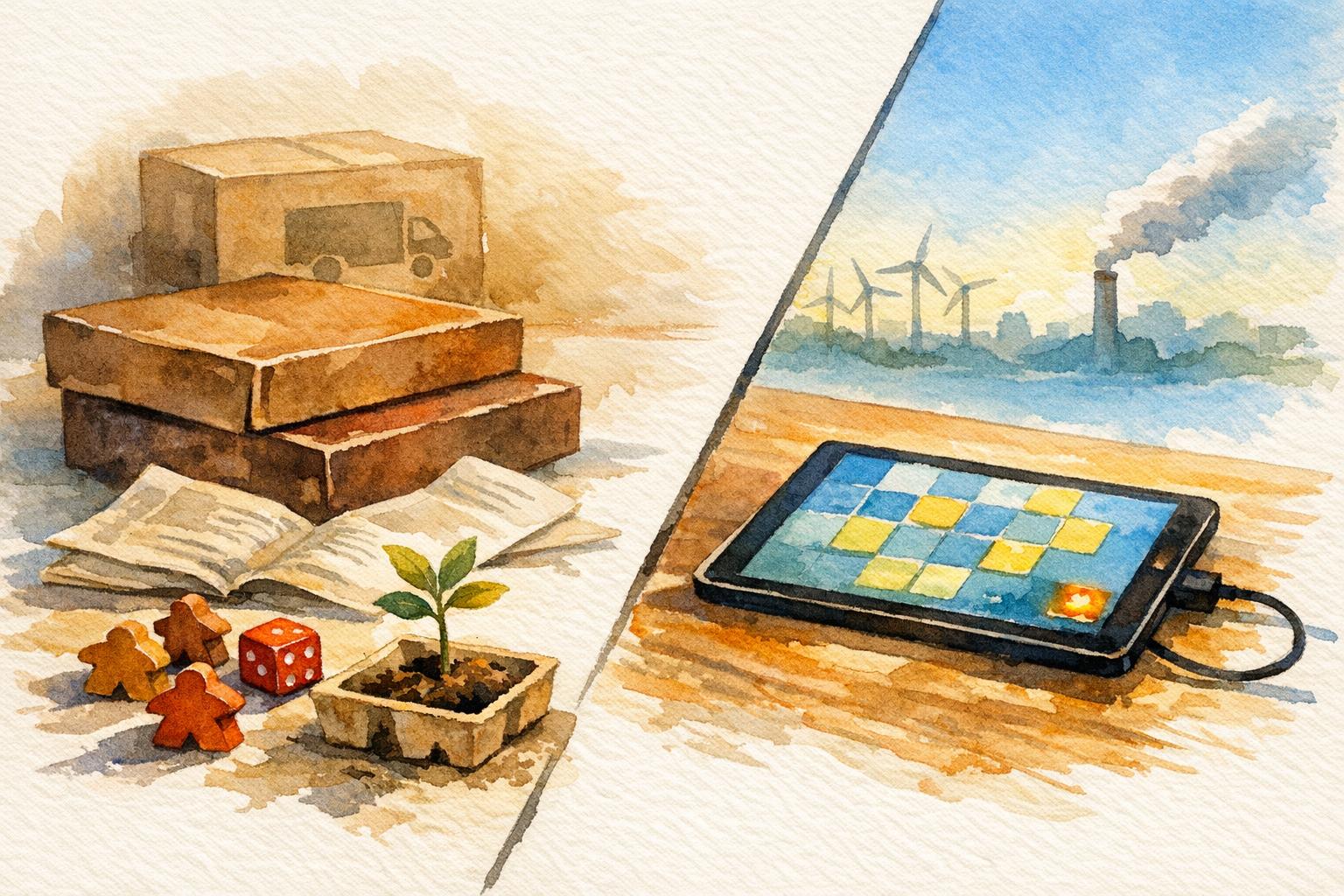
Which is greener: digital or physical board games? Both formats have their trade-offs when it comes to resource use, energy consumption, and waste.
- Physical board games: Use materials like plastic, wood, and cardboard. These often end up as waste, though some components (like FSC-certified wood) are more eco-friendly. Transport emissions also add to their footprint.
- Digital board games: Skip physical materials but rely heavily on energy. Servers, downloads, and gaming hardware (like PCs) require significant power. Larger downloads (over 1.3 GB) can even surpass the emissions of shipping physical games.
Key takeaway: Physical games last longer and can be reused, but they generate more waste. Digital games avoid plastic but contribute to e-waste and ongoing energy demands. Each has its own impact, so the greener choice depends on factors like file size, device efficiency, and material use.
Production Impact: Resource Use and Energy Consumption
Physical Board Games: Material-Heavy Manufacturing
Creating physical board games requires a wide range of raw materials. Plastics dominate many components, including miniatures, dice, acrylic cubes, shrinkwrap, baggies, and card sleeves. Meanwhile, wood is shaped into meeples, tokens, and dice, and cardboard serves as the backbone for boxes, game boards, and punchboards. Paper rounds out the mix, used for rulebooks and cards.
The environmental toll of these materials is significant. Most plastic components eventually end up in landfills or are incinerated. On the other hand, wood and cardboard are generally seen as more sustainable, particularly when they come with certifications from groups like the Forest Stewardship Council (FSC) or the Program for the Endorsement of Forest Certification (PEFC).
Some publishers are making strides to minimize their material usage. For example, in 2019, Big Potato Games replaced plastic bubble bags with fully recyclable alternatives and committed to removing plastic trays and wraps from their games. Their release “P For Pizza” was entirely plastic-free. Haba USA also took steps by swapping out plastic shrinkwrap for pull-off sticky tabs and replacing plastic bags with paper ones. Hasbro followed suit in 2020, announcing plans to phase out plastic packaging across all new toys and games.
While physical games rely heavily on raw materials, digital board games present a different kind of challenge - one centered on energy consumption.
Digital Board Games: Energy Requirements for Development
Digital board games trade physical materials for energy use. From software development to server operations and cloud storage, every stage of a digital game’s lifecycle requires a steady supply of power. Unlike physical games, where production occurs once, digital games need continuous energy to keep servers running and maintain global accessibility.
The devices used to play digital games also add to their environmental impact. For instance, manufacturing a single PC produces approximately 328 kg of CO₂ emissions over its lifetime. As Eurogamer highlights, “The manufacture, shipping, and disposal of hardware produces greenhouse gases”. Additionally, high-end gaming PCs can consume up to 20 times more energy during gameplay than devices like the Nintendo Switch. However, experts suggest that increasing efficiency could cut energy use by as much as 75% without sacrificing performance.
Physical games may have a one-time material impact, but digital games require ongoing energy, creating a clear trade-off between these two formats. Each production method leaves its own environmental mark, paving the way to explore their distribution and waste impacts further.
sbb-itb-7b84150
Distribution Impact: Shipping vs. Digital Downloads
Physical Games: Transportation and Packaging
Transporting physical board games has a wide range of carbon footprints depending on how far the games travel and the method of transportation. For example, shipping a pallet of games from Hong Kong to Hamburg by cargo ship emits roughly 280 kg of CO₂, while moving the same pallet locally - such as from Austria to Germany by truck - results in just 10.8 kg of CO₂. That’s a difference of over 25 times.
“Local production can reduce transport emissions by more than 96%.” - Polar Embassy
The mode of transport plays a big role here. Cargo ships, often used for overseas shipping, rely on heavy fuel oil, which is highly polluting. In contrast, regional trucking is much more fuel-efficient per unit transported. But it’s not just about transportation - physical games also require packaging, like cardboard boxes and plastic wrap, which adds to their environmental footprint. These factors make the distribution of physical games significantly more resource-intensive compared to digital methods.
Digital Games: Download Energy Costs
On the other hand, digital downloads come with their own environmental challenges. While they eliminate the need for physical shipping, they rely heavily on electricity to power data centers, network infrastructure, and file transfers. The carbon emissions from downloads depend largely on the file size.
For smaller files - under 1.3 GB - digital downloads produce fewer emissions. However, for larger files, such as an 8.8 GB game, the carbon footprint of the download can surpass that of shipping a physical Blu-ray disc through retail channels.
“Distribution of games by physical BDs [Blu-ray discs] results in lower greenhouse gas emissions than by Internet download… for games larger than 1.3 GB.” - Kieren Mayers, Executive in Residence, INSEAD Social Innovation Center
Even though data centers have improved their efficiency over the years, they still consume a significant amount of energy - 2% of all electricity in the United States. As game file sizes continue to grow, the energy demands for transmitting and storing these files increase, which could make physical media a more eco-friendly option for very large downloads.
Waste and End-of-Life Impact
Physical Games: Plastic and Packaging Waste
When it comes to waste and end-of-life considerations, physical board games have a clear environmental footprint. They generate waste from materials like plastics, cardboard, and paper, with plastics being the most problematic. Items such as acrylic cubes, plastic dice, miniatures, player tokens, card sleeves, storage baggies, and shrinkwrap are non-biodegradable, meaning they can linger in landfills and contribute to microplastic pollution. Shockingly, only about 10% of these plastics are recycled each year.
Cardboard and paper components are generally easier to recycle, but complications arise when these are coated or combined with plastics, making proper disposal tricky. On the bright side, physical games often have long lifespans. Owners tend to keep them in good condition for years, and they can be resold or donated, extending their usefulness.
Some publishers are stepping up to address these issues. Companies like Big Potato Games, Hasbro, and Haba USA have started using 100% recyclable packaging and alternative materials to cut down on plastic waste. While these efforts are promising, the challenges of managing physical game waste remain a pressing concern.
Digital Games: Electronic Waste and Server Maintenance
Digital games come with their own set of environmental challenges. Unlike physical games, they don’t generate plastic waste, but they contribute significantly to electronic waste. Devices used for digital gaming - such as consoles, PCs, smartphones, and tablets - have relatively short lifespans. For instance, a smartphone typically lasts about 2.5 years, a tablet around 3 years, and a gaming console averages 6.5 years. Unfortunately, only 22.3% of electronic waste was properly recycled in 2022.
This poses serious disposal problems. Take the PlayStation 4 as an example - it contains around 54 elements, including hazardous materials like lead, cadmium, and rare-earth metals. These materials can contaminate groundwater and require specialized recycling processes. Additionally, manufacturing and disposing of gaming hardware often generate more greenhouse gases than the energy used to operate the devices.
“The e-waste created from disposing video game consoles is intense – as the average PS4 contains around 54 elements that could prove harmful to our groundwater resources.”
– Stephanie Safdie, US Copywriter, Greenly
Another issue with digital games is their reliance on server maintenance. Once developers stop supporting a game or shut down its servers, the game becomes obsolete - even if players have invested time and money into it. This contrasts with physical games, which can continue to be used, sold, or donated long after their initial purchase. While digital games avoid the pitfalls of plastic waste, they bring significant challenges in managing electronic waste and ensuring sustainability in server operations.
The Environmental Impact of Digital Games // HeavyEyed
Side-by-Side Comparison: Environmental Metrics
Environmental Impact Comparison: Physical vs Digital Board Games
Comparison Table: Production, Distribution, and Waste
When comparing physical and digital board games, the environmental impacts vary significantly across production, distribution, and waste. The table below highlights these differences, offering insights for making more eco-conscious choices.
Metric Category
Physical Board Games
Digital Board Games
Production Impact
Material weight (lbs), plastic content (%), FSC/PEFC certification status
Development energy, server maintenance, hardware manufacturing energy
Distribution Carbon Footprint
Shipping weight, box volume (cubic inches), transportation CO2e - freight accounts for 8% of global greenhouse gas emissions
File size (GB), download energy (kWh/GB), data center efficiency - internet pollution accounts for 3.7% of global greenhouse gas emissions
Waste Generation
Plastic waste (miniatures/shrink wrap), recyclability (<10% for plastics), landfill volume
E-waste (hardware disposal with a 22.3% recycling rate), server energy for storage
Average Lifespan
Decades if stored properly
2.5 to 6.5 years (hardware dependent)
End-of-Life Risk
Microplastics, landfill volume
Toxic leaching (mercury, lead, arsenic)
One standout observation is that digital downloads only produce fewer carbon emissions than physical products when file sizes are under 1.3 GB. Larger files require more energy for data transfer and server maintenance, potentially surpassing the emissions involved in manufacturing and shipping physical games.
“The estimated carbon emissions from downloading only fall definitively below that of BDs for games smaller than 1.3 GB”
– Kieren Mayers, Executive in Residence, INSEAD Social Innovation Center
Another key factor is the hardware used for digital gaming. High-end gaming PCs, for instance, can consume up to 20 times more energy during gameplay compared to more energy-efficient devices like the Nintendo Switch.
Conclusion: Understanding the Environmental Trade-Offs
When it comes to environmental impact, neither digital nor physical board games come without compromises. Each has its own set of considerations.
Physical board games shine in terms of durability and reuse. A well-crafted game can last for generations, be passed along, resold, or donated, giving it an extended life. To reduce environmental impact, it’s worth opting for games made with materials like FSC-certified wood or cardboard instead of plastic-heavy components. Exploring second-hand options is another great way to lessen waste.
On the other hand, digital board games eliminate the need for plastics, shrinkwrap, and the emissions tied to shipping. They are most eco-friendly when their file sizes are small and played on energy-efficient devices like smartphones or tablets, rather than power-hungry gaming PCs. That said, if a digital download exceeds 1.3 GB, its carbon footprint can surpass that of producing and shipping a physical disc.
FAQs
How do I know if a digital game’s download is “too big” to be greener?
When a digital game download stretches into the hundreds of gigabytes, it can be considered “too big.” Such massive downloads can heavily strain your internet data plan and contribute to higher energy use across networks. This increased energy demand might offset any potential environmental advantages of choosing digital over physical copies. To minimize this impact, look for games with smaller file sizes or those that offer updates that aren’t as data-heavy.
Which matters more for digital games: the device I play on or the game itself?
The device you use for gaming has a much bigger impact on the environment than the game itself. Whether it’s a console, PC, or smartphone, these devices consume electricity during play, which adds to their carbon footprint. On the other hand, the size of a game’s data or the process of downloading it contributes far less to environmental impact. If you’re looking to make a difference, opting for energy-efficient devices and limiting usage time are far more effective strategies than worrying about the size of the game you’re downloading.
What should I look for in an eco-friendlier physical board game?
When choosing board games with the environment in mind, consider those crafted from sustainable, biodegradable, or recycled materials. For example, games that use recycled cardboard or biodegradable plastics are a step toward reducing environmental impact. Opt for games with durable pieces, like cards and boards made from recycled paper, as they last longer and create less waste. Try to avoid games with excessive plastic in their packaging or components, like miniatures. Instead, look for options that use responsibly sourced or recyclable materials to make a greener choice.