
Game Talk
Best Practices for Competitive Playtesting
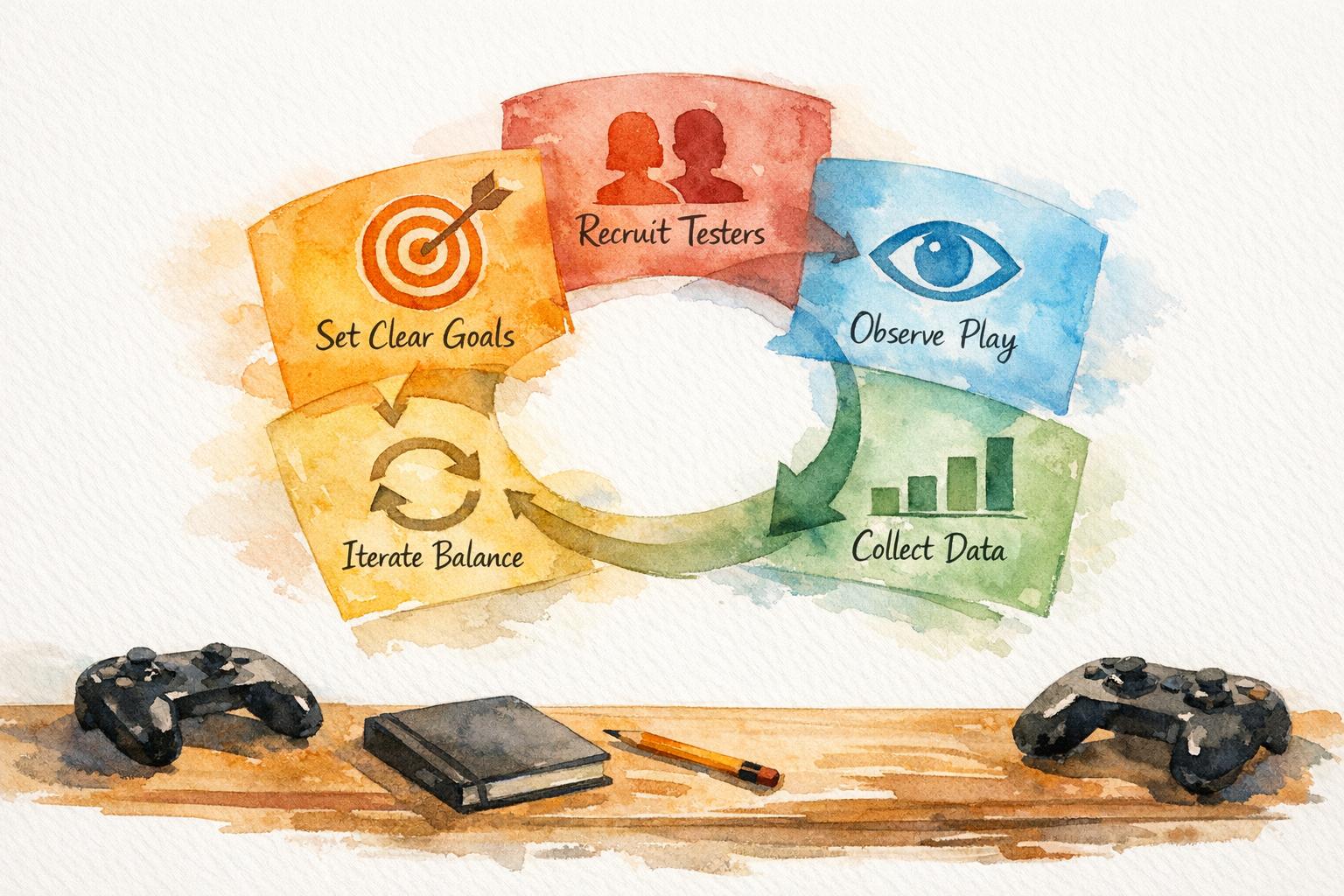
Competitive playtesting ensures your game is balanced, engaging, and fair in player-versus-player or team-based settings. It highlights issues like dominant strategies, pacing problems, or unfair advantages that solo testing often misses. Here’s how you can make the most of your playtesting sessions:
- Set Clear Objectives: Identify specific questions or hypotheses to test (e.g., “Do turns take too long?”).
- Choose the Right Testers: Select players who reflect your target audience, such as competitive gamers or unbiased strangers.
- Prepare the Environment: Minimize distractions, ensure technical setups work, and provide tools for feedback collection.
- Observe Behavior: Watch for confusion, disengagement, or unexpected strategies during gameplay.
- Gather Actionable Feedback: Use surveys, interviews, and gameplay data to identify recurring problems.
- Iterate and Test Again: Make small adjustments based on feedback and repeat the process.
6-Step Competitive Playtesting Workflow for Game Developers
Preparing for Competitive Playtesting
Getting ready for competitive playtesting involves more than just gathering players - it’s about laying a solid groundwork to ensure the feedback you gather is meaningful. The way you prepare can determine whether you walk away with actionable insights or miss the mark entirely.
Setting Clear Objectives and Metrics
Clarity is key before the first playtester even touches your game. Game designer Ignacy Trzewiczek puts it best:
“You cannot start a play-testing session without knowing what you are testing. You must know exactly what you are checking that day. What question you are looking to answer.”
Start by defining a hypothesis, like “The combat phase causes turns to exceed 5 minutes.” This gives you a clear focus for the session and ensures the data you collect - whether numbers or observations - aligns with that goal. For digital games, metrics like Day 7 retention rates can reveal whether your competitive design keeps players engaged.
A survey from the International Game Developers Association highlights that 71% of game developers view playtesting as a crucial part of their workflow. Yet, many miss out on its full potential by failing to set measurable goals. To avoid this, design specific scenarios. For example, give players “overpowered” loadouts or set up situations that test the balance of opposing strategies.
Once your objectives are locked in, the next priority is finding the right people to test your game.
Selecting the Right Playtesters
Your playtesters should reflect the type of players your game is designed for. Random selection might seem convenient, but it can lead to irrelevant or skewed feedback. Competitive players, for instance, are better at identifying late-game strategy issues, while strangers often provide more honest, unbiased opinions than friends or family .
Take Stonemaier Games as an example. They maintain a network of about 130 lead playtesters worldwide, chosen for their ability to clearly articulate what happened during play, why it happened, and how it felt - without overstepping into redesigning the game themselves. These testers are compensated and credited in the game’s documentation.
To find suitable participants, use platforms like social media, gaming forums, or even local meetups. Whether you need friends, strangers, or a mix depends on your game’s focus. Incentives like free copies, merchandise, or even snacks can encourage testers to return for future sessions .
With the right group assembled, attention turns to creating an environment that fosters productive feedback.
Creating the Testing Environment
A well-prepared environment ensures your playtesters can focus on the game without distractions or biases. For multiplayer sessions, consider using individual pods or dividers to prevent screen-peeking and reduce social pressure that might influence behavior.
Set up each station with the necessary tools - high-performance hardware for digital games or organized table space for physical ones. Recording equipment, such as webcams and software like OBS or Camtasia, can capture reactions and gameplay for later analysis .
Plan for a four-hour session with about three hours dedicated to gameplay. Use the remaining time for setup, briefings, and wrap-ups. To streamline testing, create shortcuts that allow players to jump to specific game states. Always run a pilot session to confirm everything works smoothly, from audio recording to stable multiplayer connections .
For online competitive games, ensure stable dedicated servers and have a direct line to technical support. Platforms like Discord can help with real-time communication and coordination . And don’t underestimate the value of snacks and drinks - keeping testers comfortable can lead to better, more focused feedback .
sbb-itb-7b84150
Running Competitive Playtesting Sessions
When running a competitive playtest, preparation is key to turning the session into actionable insights. A typical four-hour session includes an introductory briefing, gameplay segments with interim surveys, a final comprehensive survey, and a group discussion at the end. However, due to briefings, surveys, and potential technical hiccups, you’ll likely get about three hours of actual gameplay. This structured approach helps collect detailed behavioral data and targeted feedback, similar to iterative design in educational games.
Structuring Session Time
Start with a clear briefing to ensure players understand that the test focuses on the game, not their skills. Game designer John Brieger emphasizes that identifying confusing elements in the game leads to the most valuable insights. Treat the session like an experiment: form a hypothesis (e.g., “player turns take too long”) and structure your time accordingly. Allocate 15–45 minutes for gameplay, 10–15 minutes for debriefing, and reserve 30 minutes at the end for surveys and group discussions. These discussions are essential and require at least 30 minutes to delve into qualitative feedback.
For multiplayer tests, maintain direct communication with server engineers using platforms like Discord to address any downtime instantly. If testing features like voice chat, set up servers and assign player seats beforehand to avoid wasting time on technical adjustments during the session.
Watching Player Behavior and Interactions
“The experience of your game happens during the game, so it’s silly to only measure and record data afterwards”.
Pay close attention to player engagement throughout the session. Watch for moments when players are particularly excited or disengaged - these spikes and dips often reveal how game systems are working (or not). Signs of boredom, such as players leaning back, checking their phones, or asking, “Whose turn is it?” are especially telling.
Keep track of player questions and note specific quotes, like “I wasted a turn”, to better understand what frustrates or confuses them. These quotes can also help frame post-game discussions. If a player behaves unexpectedly, ask why. For example, did they miss an objective, or did they see it and choose to ignore it? Observing behavior alone won’t always give you the full story.
Decision hesitation during turns often signals confusion or an imbalance in the strategic weight of choices. In competitive games, watch how players react emotionally and strategically to events like being attacked or losing a key action space. Track how long individual turns and full rounds take - if rounds drag near the game’s end, it could indicate issues with the end-game economy or mechanics.
During slower moments, ask neutral questions like, “What’s happening now?” to gather unbiased feedback without revealing hidden mechanics or influencing player behavior. In physical playtests, use dividers between player stations to prevent distractions or “group-think” caused by players watching each other’s screens.
Collecting Useful Feedback
Combine multiple methods - direct observation, recordings, interviews, and focus groups - to gather well-rounded feedback. For digital games, track data such as win rates, time spent in specific areas, and weapon preferences to complement qualitative insights. Features like in-game feedback buttons that capture game state and screenshots can enable players to report issues without disrupting their immersion.
Wyatt Cheng, Lead Designer for Diablo 3 and Diablo Immortal, offers a practical tip for managing feedback:
“Only act on one piece of feedback out of four. If the other three are a problem, they will come up again. Your time and attention are a limited resource”.
This approach ensures you focus on recurring issues rather than reacting to every suggestion. For competitive playtests, you can manually set up scenarios or “stack the deck” to test specific strategies, game-breaking combos, or balance edge cases. Pay attention to players who disengage because they feel they have no chance of winning - this is a strong indicator of balance problems.
Also, observe how often players refer to rulebooks or player aids. Frequent checks during competitive play suggest that mechanics may be too complex or unintuitive. In team-based games, watch how players collaborate and communicate to tackle challenges. This can reveal how well social features and team dynamics are working.
Analyzing Results and Making Improvements
Once you’ve gathered data and observations from playtesting, the next step is turning that information into meaningful design changes. Your notes, survey results, recordings, and telemetry should all feed into actionable steps for refining the game.
Finding Patterns and Problems
Organize feedback into categories like game mechanics, level design, or UI elements. This method makes it easier to identify recurring issues. For instance, if seven out of ten players report confusion about the auction phase, that’s a clear sign of a problem that needs attention.
When analyzing issues, focus on both frequency and severity. A single complaint about card artwork isn’t as urgent as multiple players mentioning that the game feels unfair or unwinnable halfway through. For competitive games, win-loss ratios and player behavior metrics are especially helpful. If one faction dominates with a 70% win rate, there’s likely a deeper balance issue.
Importantly, document the actual problem, not the player’s suggested fix. For example, if someone says, “this card should cost 5 instead of 3,” what they’re really communicating is that the card feels too strong. It’s up to you to determine the best solution - whether that’s adjusting the cost, tweaking the effect, or something else entirely. As game designer Alexander Brazie wisely notes:
Remember, if players say there’s a problem, they’re usually right. If they suggest a specific solution, they’re usually wrong.
Deciding Which Changes to Make First
When prioritizing feedback, consider impact, frequency, and severity. Apply Wyatt Cheng’s “one in four” rule: if only one player mentions an issue and it doesn’t surface again in future tests, it’s likely not worth addressing. Your resources and time are limited, so focus on what matters most.
To keep things organized, use a simple tagging system like high/medium/low priority. High-priority issues are game-breaking or make the experience unenjoyable for most players, such as a runaway leader problem or a first-player advantage. Medium-priority issues might include confusing UI elements that slow gameplay, while low-priority items often involve cosmetic tweaks or minor balance adjustments.
When evaluating potential fixes, aim for solutions that are straightforward, address multiple problems at once, and involve incremental changes rather than overhauls. For example, if both the rulebook and player aids are confusing, a redesigned visual layout might solve both problems in one go.
Game designer Chris Kirkman puts it bluntly:
I think the hardest part for any designer is letting go. You have to be willing to kill your babies if you want to design effectively.
Once priorities are clear, you can begin refining the game through iterative changes.
Making Iterative Design Changes
Playtesting should be viewed as an ongoing cycle. After identifying and prioritizing issues, make small, targeted adjustments and test again. Adjusting numerical values like damage, health, or resource costs between rounds can quickly reveal whether balance is improving.
Keep a detailed problem log to ensure you’re addressing root causes rather than applying surface-level fixes. For example, if players take too long on their turns, the problem might not be the timer but rather decision paralysis caused by too many options.
Game designer Ben Pinchback captures the essence of the process:
Playtesting, feedback. Playtesting, feedback. Long pause. Repeat. This will never cease to be the secret to making a great game.
Each iteration should aim to answer specific questions while also uncovering new ones. Tracking changes across versions lets you measure progress and determine whether adjustments are steering the game in the right direction. For competitive games, use consistent benchmarks to maintain fairness. Metrics like “fun”, “frustrating”, or “boring” can help you monitor improvements over time. For example, if version 2.0 scores higher on “strategic depth” but lower on “clarity” than version 1.5, you’ll know exactly what trade-offs were made and can refine accordingly.
Conclusion
Competitive playtesting isn’t just a finishing touch - it’s the backbone of great game design. As Eric Lang aptly says: “Build your design process around playtesting. Everything else is theorycraft”. And it’s not just theory; 71% of game developers agree that playtesting is either critical or very important to their process.
The steps outlined in this guide - defining clear goals, choosing the right testers, observing without interference, and iterating based on data - help transform rough concepts into polished, engaging games. Whether you’re working on a complex tabletop game or a fast-paced digital multiplayer, the test-fail-fix-repeat cycle uncovers issues you’d never spot alone and ensures your game can hold its own in a competitive market.
It’s worth noting that while playtesters are great at pointing out problems, they’re not there to solve them for you. Your role is to dig into the feedback, look for recurring patterns across sessions, and apply strategies like the “one-in-four” rule to focus on what truly matters. By prioritizing the issues that significantly affect the player experience, you can make the most of your time and resources.
And remember, this process is ongoing. As Ben Pinchback puts it: “Playtesting, feedback. Playtesting, feedback. Long pause. Repeat. This will never cease to be the secret to making a great game”. Each cycle of testing and iteration gets you closer to crafting a game that’s more than just functional - it’s one that players will genuinely enjoy.
So, start testing early, embrace failure, and let player behavior guide your decisions. That’s the path to creating a game that keeps players coming back for more.
FAQs
What metrics should I track to prove my PvP balance is improving?
To gauge whether your PvP balance is heading in the right direction, focus on tracking metrics that highlight both fairness and player engagement. Two key indicators to watch are the win ratio - with a target of roughly 50% for each side - and player performance stats, like skill levels and match results. These metrics reveal how well your matchmaking system pairs players with comparable abilities. Keeping an eye on these trends over time not only demonstrates progress but also helps fine-tune game mechanics to create a more balanced and competitive experience.
How many playtesters do I need for a competitive playtest to be reliable?
For dependable feedback, aim to include around 6 players per target audience type. This number provides a good balance - enough participants to identify key issues without becoming unmanageable. Including more players typically results in diminishing returns. Also, make sure the group accurately represents your target audience to gather the most relevant insights.
How do I tell the difference between a dominant strategy and a player skill gap?
A dominant strategy refers to a choice that consistently provides the best outcome for a player, no matter what decisions others make. It’s like having a trump card that works in every scenario.
On the flip side, a skill gap stems from differences in players’ abilities, experience, or knowledge of the game. This gap can shrink over time as players improve their skills or understanding.
To tell them apart, consider this: Is the advantage coming from a decision that’s inherently the best (dominant strategy)? Or is it due to differences in skill or execution that could level out with practice or learning (skill gap)?